History of Nocatee, Florida: How the Community Developed
If you live in Nocatee today, it's hard to imagine it without Town Center, the water parks, schools, golf carts, neighborhood parks and homes stretching from Twenty Mile to Seabrook.
But one of the things I've always found most interesting about Nocatee is how much of the community we know today was planned long before any of it existed.
Nocatee wasn't created one neighborhood at a time. The original vision was much bigger.
In the late 1990s, The PARC Group began working with the Davis family to plan approximately 25 square miles of Davis family land between the Intracoastal Waterway in Palm Valley and U.S. 1. The vision included not only neighborhoods, but roads, schools, recreation, shopping, employment, public services and large areas of preserved land.
What followed was more than two decades of development that gradually turned that plan into the Nocatee we know today.
Before Nocatee, There Was the Land
Long before Nocatee Parkway or Town Center existed, this part of Northeast Florida was largely undeveloped land owned by the Davis family.
The history of the land itself goes back much further, particularly around what we now know as Twenty Mile. There's a fascinating story behind the historic Twenty Mile House, Dee Dot Ranch and even how Twenty Mile got its name.
That's a story worth telling on its own.
For this article, we're starting in the late 1990s, when the idea of Nocatee began taking shape.
A Community Planned Before It Existed
What makes Nocatee's history unusual is the scale of the original plan.
This wasn't simply a collection of subdivisions that eventually grew together. The vision considered how people would move through the community, where they would shop and recreate, where schools and public services could go, and which areas would remain undeveloped.
The development plan was approved in 2001, but approval was only the beginning.
Before thousands of people could live here, the infrastructure had to come first.
Building the Infrastructure Before the Homes
The PARC Group broke ground in 2005 with construction of Nocatee Parkway, a project estimated at approximately $150 million. The Parkway would eventually become the major east-west connection through Nocatee, linking the Palm Valley area near the Intracoastal with U.S. 1. (Nocatee News)
But roads were only part of it.
Water, sewer, electric and stormwater systems all had to be planned for a population that didn't exist yet.
Nocatee Parkway celebrated its ceremonial opening in March 2007.
By then, Nocatee's first neighborhoods were beginning to take shape: Del Webb Ponte Vedra (Riverwood), Willowcove, Austin Park and Coastal Oaks.
Nocatee's First Residents
On April 4, 2007, Roberta and Gerry Moore moved into their new home in Austin Park as Nocatee's first residents. This particular piece of Nocatee history has a special connection for us because we had the opportunity to sell their Austin Park home years later.
There's a plaque in the front yard placed by The PARC Group recognizing the significance of the home. It's one of those little pieces of Nocatee history you could easily drive past without knowing the story behind it.
When the Moores arrived, Nocatee looked nothing like it does today. There was no established Town Center and certainly no network of neighborhoods extending all the way through Crosswater and Seabrook.
Those earliest homeowners weren't simply buying homes in an established community. They were buying into the vision of what Nocatee was supposed to become.
And almost immediately, that vision faced a pretty significant test.
Then the Housing Market Collapsed
Nocatee's earliest years happened to coincide with the Great Recession and one of the worst housing markets Florida had experienced in decades.
New construction slowed. Buyers disappeared. Development projects throughout Florida stalled.
But Nocatee kept building.
Major roads continued. The Publix shopping center moved forward. And so did an amenity that must have seemed pretty ambitious for a community with only hundreds of residents: Splash Water Park.
By 2011, less than 65 new homes were sold in Nocatee for the entire year.
Looking back now, it's easy to assume Nocatee's amenities came because the community was already successful.
That's not really how it happened.
Many of them were being built for the community the developers believed Nocatee would eventually become, and they did not scale back their plans during the recession.
Splash Opens in 2010
Splash Water Park opened in 2010, right in the middle of that downturn.
Think about that for a minute.
There were still only hundreds of residents, yet Nocatee was opening the kind of major amenity we now associate with a much larger established community. Our Austin Park neighbors describe having the entire waterpark to themselves because there were so few residents.
By the time the housing market began recovering, buyers weren't looking only at renderings and promises. Roads, shopping and major amenities were already becoming part of everyday life in Nocatee.
And then things began moving much faster.
Town Center Starts Feeling Like a Town Center
Early Nocatee residents didn't have the Publix, restaurants, medical offices and services we take for granted today.
Town Center filled in gradually as Nocatee grew.
By 2014, new businesses were arriving, new neighborhoods were opening and home sales had accelerated dramatically.
Eventually, Town Center became exactly what its name suggests: the everyday center of the community.
And if you want to see just how dramatically the pace of development changed, the neighborhood timeline tells the story better than I ever could.
The Evolution of Nocatee
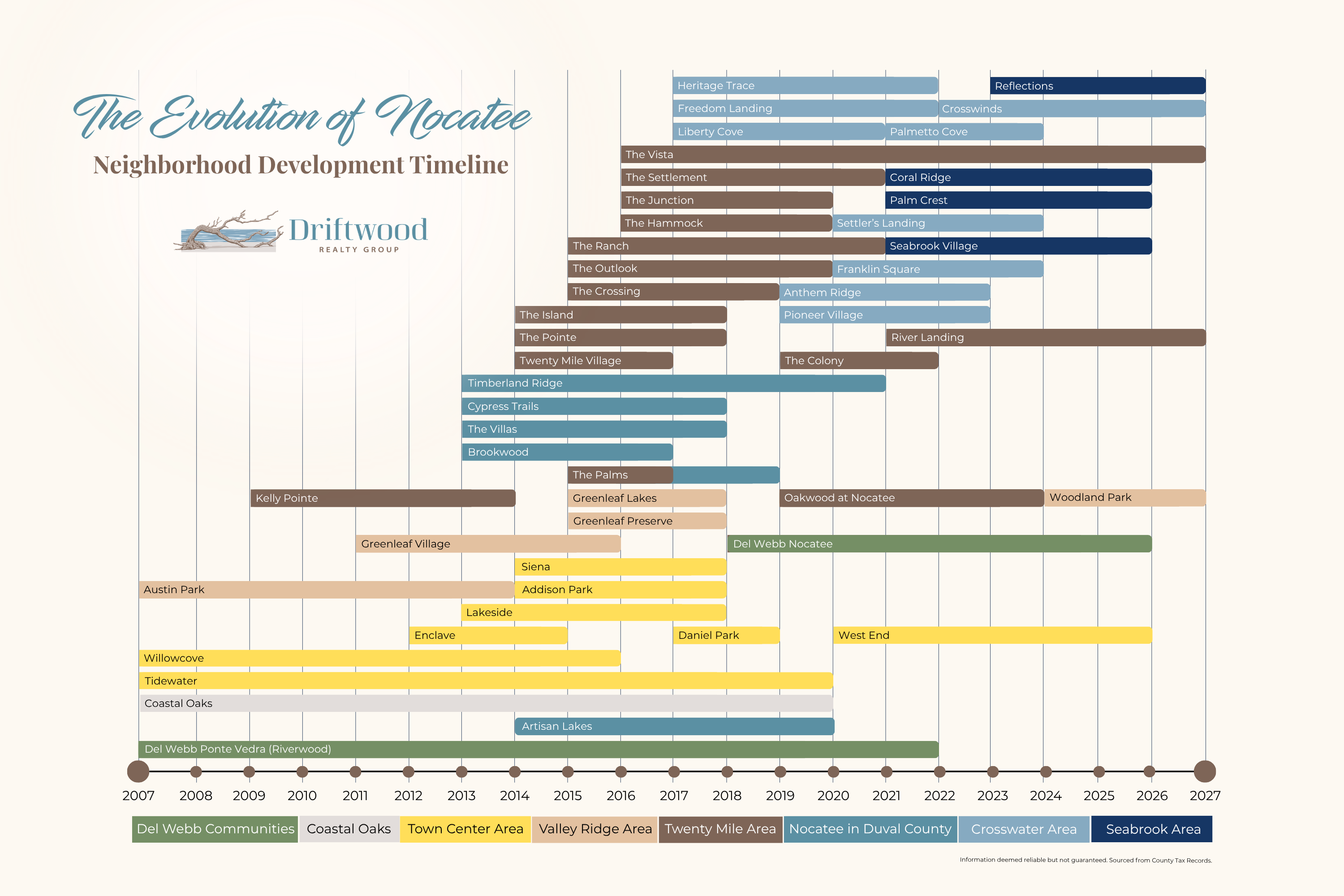
When I put this timeline together using County property records, what jumped out at me was the change that happens in the middle of the chart.
The earliest neighborhoods developed over a relatively long period. Then, beginning around the middle of the 2010s, Nocatee really starts spreading outward.
New neighborhoods weren't just filling in around Town Center anymore. Entire new areas of Nocatee were taking shape.
Twenty Mile Changes the Map
Twenty Mile was announced in 2014, bringing development northeast into an area designed to feel noticeably different from the earlier parts of Nocatee.
The mature oak canopy, split-rail fencing, preserved land and Old Florida character weren't accidental. The area's design was meant to reflect the history and landscape that were already there.
Over the following years, Twenty Mile grew into a collection of neighborhoods with a surprisingly wide range of homes and homesite sizes.
It's also the area where Nocatee's modern development story intersects most clearly with the much older history of the land.
That's why we're giving Twenty Mile's history its own article: The History of Twenty Mile: From Historic Florida to Nocatee
Then Came Crosswater and Seabrook
Development also continued south.
Crosswater grew into its own large section of Nocatee with multiple neighborhoods, parks, lakes and trails. Later, Seabrook extended the community farther south again.
When you look back at the timeline, you can actually watch Nocatee transform from a relatively small group of early neighborhoods into the much larger community we recognize today.
And the amenities grew along with it.
The Amenities Grew Too
Splash wasn't the end of Nocatee's amenity development.
Pools, athletic courts, neighborhood parks, playgrounds, dog parks and miles of Greenway trails were added over the years. An Intracoastal kayak launch opened in 2014, and Spray Waterpark followed in 2019.
Some amenities serve the entire community. Others give individual areas their own identity.
That's another reason two Nocatee neighborhoods only a few miles apart can offer very different experiences.
But some of the most important pieces of Nocatee aren't things that were built at all.
What Nocatee Didn't Develop Matters Too
Preservation was part of the plan from the beginning.
The Nocatee Preserve protects approximately 2,400 acres and 3.5 miles along the Intracoastal Waterway, while wetlands, conservation areas and greenway corridors are woven throughout the larger community. (Nocatee News)
You see the results everywhere.
Preserve views behind homes. Woods separating neighborhoods. Wildlife corridors. Greenway trails. Wetlands. Mature trees that were incorporated into later areas such as Twenty Mile.
In a community this large, what wasn't developed is an important part of Nocatee's history too.
From a Master Plan to 49 Neighborhoods
Today, Nocatee includes 49 residential neighborhoods, but they weren't built at the same time, by the same builders or for the same type of homeowner.
That's something I think is easy to miss when you're first looking at Nocatee on a map.
An early Town Center neighborhood doesn't necessarily look or feel like Twenty Mile. Twenty Mile is different from Coastal Oaks. Crosswater has a different setting from Seabrook. The active-adult communities have their own characteristics, and the portion of Nocatee in Duval County is different again.
Once you understand when and where Nocatee grew, those differences make much more sense.
It's also why we've organized our Nocatee neighborhood resources into eight areas rather than simply handing buyers a list of 49 neighborhood names.
The history helps explain the real estate.
The Nocatee We Know Today
More than two decades have passed since that original vision began taking shape.
Nocatee has lived through a housing crash, periods of rapid growth and years when entire new sections of the community seemed to appear on the map.
We've watched Town Center grow into a place where residents can run everyday errands by golf cart. We've watched amenities expand, four K-8 schools open and new neighborhoods move farther north and south.
And Nocatee is still evolving.
What I find most interesting when looking back at its history is just how much of today's community can be traced to decisions made long before most of the homes were here.
What once existed largely on a master plan eventually became 49 different neighborhoods and one very interconnected community.
Understanding how that happened gives you a completely different perspective on Nocatee today.
Frequently Asked Questions About Nocatee's History
When did development of Nocatee begin?
Planning began in the late 1990s, with the development plan approved in 2001. The PARC Group broke ground on Nocatee Parkway in 2005.
When did Splash Water Park open?
Splash opened in 2010, while Nocatee still had only hundreds of residents.
How many neighborhoods are in Nocatee?
Nocatee has 49 neighborhoods, which we've organized into eight areas to make it easier to understand how the community is laid out and how its different neighborhoods relate to one another.
Continue Exploring Nocatee
Explore Nocatee's 49 Neighborhoods
See how Nocatee is organized into eight areas and find the neighborhoods that fit the way you want to live.
Search Homes for Sale in Nocatee
Browse current Nocatee listings and see what's available across the community.
Download the Nocatee Community Real Estate Guide (coming soon)
Get our comprehensive Nocatee resource for understanding the neighborhoods, amenities and real estate throughout the community.
Curious what your Nocatee home is worth? Request a complimentary home value consultation and learn how today's market may impact your home's value. Call 904.826.3690
Whether you're just beginning your research, planning your next move, or have proudly called Nocatee home for years, we're here to help every step of the way.
Nocatee Real Estate Market Trends, Prices & Insights
See what's happening in the Nocatee housing market, including pricing, inventory and trends buyers and sellers should understand.Nocatee Greenway Trails
Explore Nocatee's greenway trails, multi-use paths and the outdoor connections that wind through the community.Nocatee Wildlife | What Animals You'll See Living in Nocatee
Learn about the deer, birds, gopher tortoises, alligators and other wildlife you may encounter living in Nocatee.Schools in Nocatee for Families Relocating
Understand the schools serving Nocatee, how zoning works and what relocating buyers should know before choosing a neighborhood.What's It Really Like Living in Nocatee? A Resident's Perspective
Go beyond the amenities and real estate to see what everyday life in Nocatee is really like from a longtime resident's perspective.Why We Chose Nocatee: Our Family's Story
Read how we first discovered Nocatee, eventually made it home and watched the community grow while raising our family here.Nocatee Dog Parks & Pet-Friendly Living
Explore Nocatee's dog parks, trails and outdoor spaces, plus practical considerations for living here with pets.The History of Twenty Mile in Nocatee
Go back before today's neighborhoods to discover the history of the land, Dee Dot Ranch and the story behind the name Twenty Mile.Nocatee HOA & CDD Fees Explained | What Every Buyer Should Know
Understand how Nocatee's HOA and CDD fees work, what they help support and what buyers should compare between neighborhoods.History of Nocatee, Florida: How the Community Developed
Follow Nocatee's evolution from its original master plan through the development of Town Center, amenities and 49 neighborhoods.Nocatee Amenities: What It's Really Like to Live Here
Explore the water parks, neighborhood pools, fitness, trails, events and recreation that make up Nocatee's extensive amenity system.Nocatee Landing: Where Nocatee Meets the Intracoastal
Explore Nocatee Landing, with kayak and paddleboard access to the Intracoastal, waterfront views, and a connection to the Nocatee Preserve.