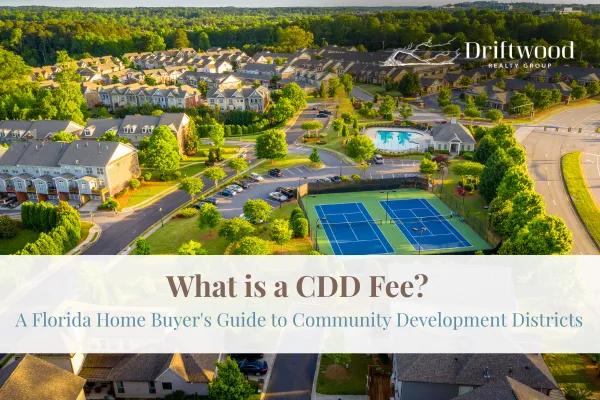
What Is a CDD Fee in Florida? What Home Buyers Need to Know
If you're searching for homes in Nocatee, eTown, Shearwater, Beachwalk, or many other newer communities throughout Florida, you've probably come across three letters that aren't familiar to buyers from many other states: CDD.
And naturally, the questions start.
What is a CDD fee?
Is it the same as an HOA?
How much will it add to my monthly payment?
Does it ever go away?
Should I avoid buying a home that has one?
The short answer is that a CDD isn't necessarily a good thing or a bad thing.
It's simply part of the cost structure of many Florida communities, and buyers should understand exactly what they're paying before deciding whether a home fits their budget and lifestyle.
Here's what you need to know.
What Does CDD Mean?
CDD stands for Community Development District.
A Community Development District is a special-purpose unit of local government created under Florida law to help finance, build, operate, and maintain infrastructure and community improvements.
In many newer developments, significant infrastructure has to be created before or while homes are being built.
That can include things like:
Roads and sidewalks
Water and sewer infrastructure
Stormwater systems
Street lighting
Parks and playgrounds
Walking and biking trails
Amenity centers
Pools and recreation facilities
Community landscaping
Lakes, ponds, and irrigation systems
Rather than putting the entire cost of those improvements into the original purchase price of each home, some communities finance part of that infrastructure through bonds.
Homeowners within the district then help repay those costs over time through CDD assessments.
How Do CDD Fees Affect Your Monthly Payment?
This is one of the most important things for buyers to understand.
A CDD assessment is generally included on the property's annual tax bill rather than sent as a separate monthly bill.
If your mortgage lender escrows your property taxes, the cost is typically incorporated into the monthly amount your lender collects.
That means your true monthly housing expense may include:
Principal
Interest
Property taxes
Homeowners insurance
Mortgage insurance, if applicable
HOA fees
CDD assessment, if applicable
This is why two similarly priced homes can have noticeably different monthly costs.
A $600,000 home without a CDD may have a different total monthly obligation than a $600,000 home with a significant annual CDD assessment.
Purchase price alone doesn't tell you what a home will actually cost each month.
That is one reason we encourage buyers to compare the entire cost of ownership when evaluating homes.
Helpful Resource:
Use our Home Affordability Calculator to estimate how different costs may affect your monthly budget.
How Much Is a CDD Fee?
There isn't one standard CDD amount.
Assessments vary from community to community and can even vary between homes within the same development.
Factors may include:
The district's infrastructure costs
Community amenities
Lot or property classification
The phase of development
The particular bond associated with the property
Remaining bond debt
Annual Operations & Maintenance expenses
That's why we don't recommend assuming that every home in a particular community has the same CDD.
When you're considering a specific property, verify the assessment for that property.
Does a CDD Fee Ever Go Away?
This is where CDDs can be confusing because what people casually call "the CDD fee" may actually contain two different components.
Bond Debt
The debt portion is associated with repayment of bonds used to finance qualifying community infrastructure.
Those bonds generally have a defined repayment period.
Once the applicable bond debt is fully repaid, that portion of the assessment can end.
Operations & Maintenance
The Operations & Maintenance portion, often called O&M, pays for ongoing expenses associated with operating and maintaining the district's infrastructure and facilities.
That may include maintaining landscaping, common infrastructure, recreational facilities, stormwater systems, and other district responsibilities.
Unlike the bond portion, O&M generally continues even after the original bond debt has been paid off because the community still has ongoing operating expenses.
So when someone tells you:
"The CDD gets paid off in 30 years."
Ask a second question:
Are we talking about the bond portion or the entire CDD assessment?
They're not necessarily the same thing.
Can You Pay Off a CDD Early?
Sometimes.
Depending on the district and the bond structure associated with the property, a homeowner may be able to make a lump-sum payment toward the remaining bond debt.
If the bond portion is paid off, that portion of the annual assessment may no longer appear in future years.
However, paying off the bond generally does not eliminate the ongoing Operations & Maintenance assessment.
Before making that decision, request the current payoff information directly from the applicable Community Development District and understand exactly what portion of the assessment would remain.
CDD vs. HOA: What's the Difference?
This is probably the most common source of confusion.
A CDD and an HOA are not the same thing, and a community can have both.
CDD
A Community Development District may finance, operate, or maintain infrastructure and community facilities.
Its assessment is commonly included on the property tax bill.
HOA
A Homeowners Association governs the private community and typically handles things such as:
Architectural standards
Community rules and restrictions
Private common areas
Association landscaping
Community management
Enforcement of covenants
HOA assessments are generally paid directly to the homeowners association according to its billing schedule.
So if you're comparing homes, don't ask only:
"What's the HOA?"
Ask:
"What are the HOA dues, CDD assessment, property taxes, and other recurring community costs?"
That's the number that gives you a much clearer picture.
Why Do So Many Florida Communities Have CDDs?
Florida has experienced tremendous residential growth, particularly in large master-planned communities.
Building an entire community requires much more than constructing houses.
Developers may need roads, utilities, stormwater infrastructure, parks, trails, landscaping, and recreational facilities.
CDD financing is one method used to fund that infrastructure over time.
That is one reason you often encounter CDDs in communities with extensive amenities and newer infrastructure.
Are CDD Communities More Expensive?
Not necessarily.
They have an additional assessment, but that doesn't automatically make them a worse financial choice.
You have to compare the whole picture.
For example, one community might have:
A higher CDD
Extensive amenities
Newer infrastructure
Miles of trails
Multiple pools
Parks and recreation facilities
A community lifestyle and events department
Another community may have no CDD but:
Higher HOA dues
Fewer amenities
Older infrastructure
Different maintenance responsibilities
The right question isn't:
"Does this house have a CDD?"
It's:
"What am I receiving for the total amount I'm paying, and does that fit the way I want to live?"
Should You Avoid Buying a Home With a CDD?
Not simply because it has a CDD.
Many highly desirable Florida communities use CDD financing.
Instead, look at whether the overall cost and benefits make sense for you.
Before purchasing, consider:
The annual CDD assessment
HOA dues
Property taxes
Homeowners insurance
How much you'll use the amenities
The remaining bond term
Whether the bond has already been paid off
The community's ongoing O&M assessment
How the total monthly cost fits your budget
A CDD should be part of your analysis, not automatically a reason to rule out a home.
What About CDD Fees in Nocatee?
Nocatee is a perfect example of why buyers should look at the individual property, not just the community name.
Nocatee contains many neighborhoods developed at different times, with different builders, lot types, associations, and district structures.
The HOA and CDD associated with one Nocatee home may be different from another home elsewhere in the community.
If you're comparing Nocatee neighborhoods, we can help you look beyond the listing price and understand:
HOA dues
CDD assessments
Property taxes
Amenity access
Neighborhood differences
Builder history
Overall monthly ownership costs
How to Find the CDD on a Home You're Considering
When you're interested in a particular home, don't rely solely on a listing description or an estimate from another property.
CDD information can be verified through sources such as:
The property's tax bill
The applicable Community Development District
District financial and assessment records
Information obtained during the purchase process
If you're working with us, we'll help identify the CDD information associated with the property you're considering so you can evaluate it as part of the overall cost.
Frequently Asked Questions
Is a CDD fee the same as an HOA fee?
No. A CDD and an HOA serve different purposes. A community may have a CDD, an HOA, both, or neither.
Is a CDD included in my mortgage payment?
If your lender escrows property taxes and the CDD assessment appears on the tax bill, the amount is generally incorporated into the escrow portion of your monthly mortgage payment.
Does every Florida neighborhood have a CDD?
No.
CDDs are commonly found in newer and master-planned developments, but many Florida neighborhoods do not have one.
Can two homes in the same community have different CDD fees?
Yes.
Assessments can vary based on the property, development phase, bond structure, lot classification, and other factors.
Does a CDD ever completely disappear?
The bond portion may end once the applicable debt has been repaid. However, the Operations & Maintenance portion generally continues because the district still has ongoing expenses.
Can I pay off the CDD when I buy the house?
Some districts allow homeowners to pay off the remaining bond portion. The O&M portion generally remains. Always obtain the actual payoff information from the applicable district before making that decision.
Is buying in a CDD community a bad investment?
Not necessarily.
The better question is whether the home's total ownership cost, location, amenities, and community features make sense for your budget and long-term plans.
Don't Compare Home Prices Alone
Two homes can have the same purchase price and very different monthly costs.
Before choosing a home, look at the complete picture:
Purchase price + financing + taxes + insurance + HOA + CDD + ongoing ownership costs.
That's how you compare homes realistically.
At Driftwood Realty Group, we'll help you understand those numbers before you make an offer so you can choose a home that works for both your lifestyle and your budget.
Ready to Start Your Home Search?
Whether you're buying your first home, relocating to Northeast Florida, or searching for your forever home, we're here to help every step of the way.
Download our complimentary Driftwood Home Buyer Guide for a complete step-by-step overview of the buying process.
Search Homes for Sale in Northeast Florida to explore the latest listings.
Want a more personalized experience? We'll build a custom MLS search based on your budget, preferred communities, lifestyle, and must-have features, so you only receive homes that truly match what you're looking for.
Buying a home should feel exciting, not overwhelming. We're here to help you move forward with confidence.
Continue Your Home Buying Journey
You may also enjoy: